OTODRIVE & OTOARM
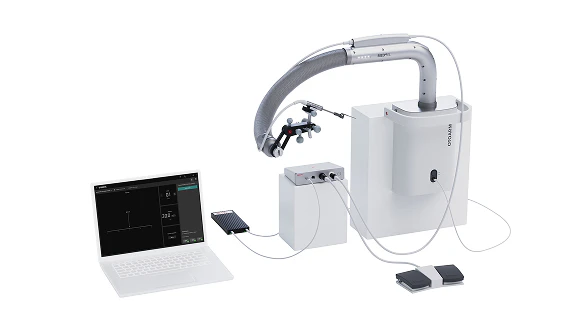
Precision Tools for Otological Surgery
A deaf ear is not a dead ear. Even in profound sensorineural hearing loss, the cochlea is full of living neural structures.
To preserve delicate cochlear structures, we have collaborated with some of the world’s leading surgeons, researchers, and engineers to design and develop precision tools that can help provide you and your patients with peace of mind and more consistent surgical outcomes.
A growing body of research underscores the importance of surgical factors such as slow, steady, and stable electrode array insertion in minimizing the risk of cochlear trauma.[ft][ft][ft][ft][ft][ft][ft][ft][ft][ft][ft][ft]
OTODRIVE
Redefining the Limits of Otological Surgery
Designed to help preserve cochlear structures, OTODRIVE can help you reduce insertion speed while keeping it consistent beyond human capabilities.[ft][ft][ft]
Compared to manual insertion, OTODRIVE-assisted insertion can:
- Significantly reduce insertion force and strong pressure peaks[ft]
- Help keep cochlear structures intact[ft]
- Lower post-operative impedance values[ft]
Complete Control of Motion Speed
Maintain slow, steady movement between 0.1 to 1.0 mm per second for more controlled electrode placement and more consistent surgical outcomes compared to manual insertion.[ft][ft][ft]
Forward & Backward Movement
Move compatible devices forward and backward with a range of motion up to 40 mm.
Slim & Lightweight Handpiece
Preserve your view of the surgical field with the tiny-tipped handpiece and make surgical handling simple.
Surgeon in Full Control
Have complete control throughout the surgical procedure. Start, stop, or change the direction of movement with a simple step on a pedal.
Designed for Efficient Setup
OTODRIVE integrates effortlessly into established clinical workflows, delivering enhanced precision with minimal impact on operating room time.[ft][ft]
OTODRIVE Software
Follow the intuitive guided workflow and visualize the procedure with any Windows-based laptop or desktop computer.
Convenient Connectivity & Power Options
Power OTODRIVE via USB-C without using a conventional power outlet and exchange data with devices via Ethernet or Bluetooth®.
Economical & Environmentally Friendly
Cut ongoing costs and reduce waste by avoiding single-use solutions.
OTOARM
Precise Surgical Tool Positioning
Accurately position surgical tools and reduce natural hand tremor with OTOARM and OTOARM Aligner.
Easy Adjustment
Remain in full control and reach a wide range of positions with one simple hand movement.
Accurate OTOARM Aligner
Adjust, fine-tune, and hold surgical instruments exactly in the desired position and angle with five degrees of freedom.
Easy OR Integration
Easy to set up on the OR table rail, while leaving space for other equipment since it has a small footprint.
Clear Field of View
The slim design allows a wide view of the surgical field.
Surgical Flexibility
Gain flexibility to use your hands where you want and reduce natural hand tremors for increased accuracy.
Versatile Applications in the OR
Precisely position and hold compatible otological instruments.*
Light, Ergonomic, and Portable Design
Set up, transport, and easily integrate OTOARM into your OR.
Convenient Power Supply
Power OTOARM conveniently via USB-C without using a conventional power outlet.

Why MED-EL:
A Trusted Partner
For more than 35 years, MED-EL has been a trusted partner and innovation leader in hearing implants. We’re here to work together with you, and we’re committed to providing outstanding service and support for our professional partners.
With the most advanced cochlear implant systems, we offer the best hearing experience for your patients and the best clinical experience for you.
Precision Tools for Otological Surgery
Ask your local MED-EL representative for more information.
Technical Data
OTODRIVE
| Operating length | 40 mm |
| Available motion speeds | 0.1 mm/s – 1.0 mm/s |
| Power requirements | USB-C power source: min. 5V and 1.5A Power via Ethernet (PoE) power source: min. IEEE 802.3 at Type 1 |
| Data connectivity | Bluetooth wireless communication Ethernet cable for direct data connection |
| Power source requirements | IEC 62368-1:2018 or IEC 60601-1:2015 compatible with USB-C PD IEC 62368-1:2018 or IEC 60601-1:2015 compatible with PoE |
| Ingression protection | OTODRIVE Box: IP20 OTODRIVE Foot Pedal: IPX8 |
| Hardware requirements | PC or Laptop/Notebook with one of the supported Microsoft® Windows® operating systems Dual-core processor with a clock speed of 1.6 GHz or higher and 2 GB of RAM or more 2 GB free disk space or more One free Ethernet port or Bluetooth capability |
| Software requirements | Windows® 8.1 or later |
OTOARM
| Arm length | 90 cm |
| Weight | ~10 kg |
| Power requirements | USB-C power source: min. 20 V and 2 A |
| Power source requirements | IEC 62368-1:2018 or IEC 60601-1:2015 compatible with USB-C PD |
| Ingression protection | IP20 |
| Compatible rail requirements | ISO 19054 compliant Minimum length of 60 cm |
| Maximum payload | 900 g |
*For compatible devices, refer to the relevant instructions for use. All devices are sold separately.
The Bluetooth® word mark and logos are registered trademarks owned by the Bluetooth SIG, Inc. and any use of such marks by MED-EL is under license.


